Using Proxies for Pricing Intelligence: Architecture and Pitfalls
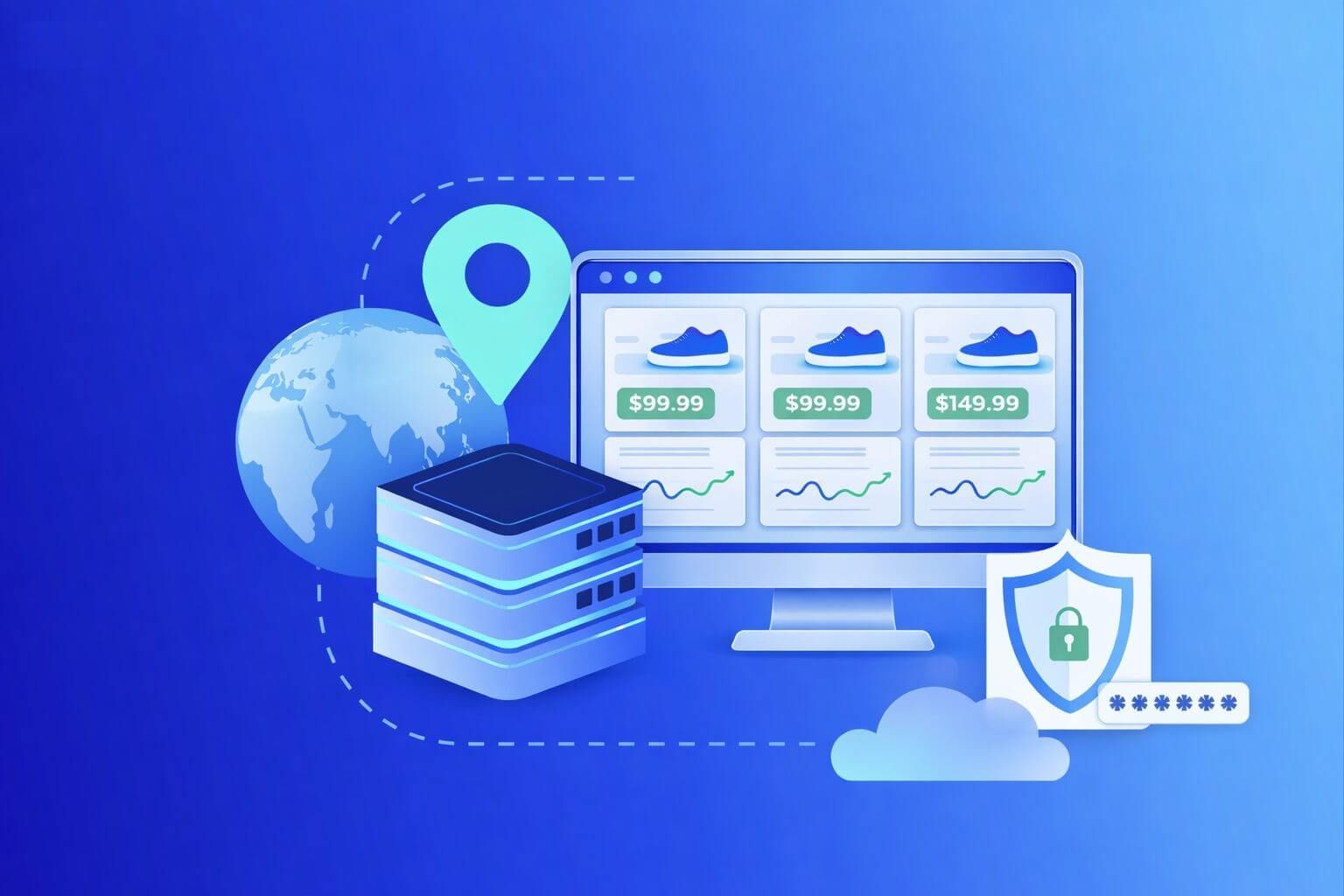
Your pricing feed keeps breaking. Some sites show 403s, others serve decoy prices, and a few throttle you so hard that your daily crawl misses key SKUs. This article explains how to design, run, and monitor proxies for pricing intelligence so your data stays fresh, accurate, and defensible. What you’ll get: a production-grade blueprint you can adapt this quarter.
Proxies for pricing intelligence route requests through diverse IPs and geos to collect market prices without triggering rate limits or WAF blocks. The best setup pairs the right IP types with session management, throttling, and validation. Start small, measure block rate and data accuracy, then scale with rotation, country targeting, and headless browser control where required.
Why pricing teams care about the proxy layer
Pricing ops live on three signals: coverage (how many products and sites you capture), freshness (how often you update), and accuracy (did you fetch the real price for the right SKU and locale). Your proxy strategy drives all three.
- Coverage rises when you reach more markets with clean geo-targeting.
- Freshness rises when sessions survive long enough to crawl categories and pagination.
- Accuracy rises when IPs, headers, and cookies align with real users in that market.
If you’re mapping use cases and data types, it’s worth skimming broader proxy use cases to see where pricing overlaps with reviews, inventory checks, and local search.
Core architecture for reliable price collection
A good architecture is simple to reason about and easy to monitor. Keep each layer observable so you can diagnose whether a failure is proxy, request, or site logic.
Data sources and request planning
Start with a source inventory. Classify each site by anti-bot strength, session needs, and login requirements.
- Light: static pages, simple pagination, minimal bot defense.
- Medium: JS-rendered prices, geo gates, modest WAF.
- Heavy: login or cart flow, dynamic APIs, strict velocity rules.
Plan your cadence. Price pages usually change slower than inventory or promotions. Set crawl frequencies by category and region. Use sitemaps, category listings, and internal APIs before resorting to complex flows.
Throttle your concurrency per domain. Many sites accept steady, human-like pacing better than spikes. Add jitter to intervals. Respect robots.txt where your policy requires; coordinate with legal on permitted collection.
Session management and cookies
Session management is more than rotating IPs. Keep a session alive across a category crawl so prices reflect the same persona.
- Persist cookies for the session scope. Reset when you see geo, currency, or language drift.
- Use session affinity for 5–20 requests where sites care about continuity.
- Mimic natural navigation: category → product list → product page → related products.
For JS-heavy sites, headless browsers help. Use them only where needed, and cache what you can.
Captcha and WAF handling
Captchas and WAFs are feedback signals. Treat them as telemetry, not just obstacles.
- Detect challenge types (Captcha, 403, 429, device fingerprint checks) and tag them.
- Lower burst rates and widen geo pools when challenges spike.
- Consider solving captchas only for must-have flows; it’s expensive and slow.
Instrument retries with exponential backoff and per-domain budgets. Stop on repeated challenges to avoid burning IP reputation.
Choosing proxies for pricing intelligence
Your IP choice drives block rate, cost, and speed. Make it a deliberate decision, not a default.
- Residential IPs: Best for hard targets, local variants, and dynamic front-ends that profile typical consumers. See the overview on residential proxies for how they appear as household traffic.
- Mobile IPs: Useful when sites gate by ASN or favor mobile user agents. Expensive; use sparingly.
- Datacenter IPs: Fast, predictable, and cheaper. Good for light and medium targets, bulk pagination, and API endpoints that don’t profile heavily.
Rotation strategy matters as much as type.
- Sticky sessions: Hold an IP for several requests to mimic real use. Reset on signs of risk.
- High-churn rotation: For single-shot fetches like PDP price calls. Keep TTLs short.
- Geo targeting: Align IP country (and sometimes city) with the site’s expected user. Validate geo accuracy at session start.
Mid-article reminder: proxies for pricing intelligence should match your site mix. Use datacenter speed where allowed, and fall back to residential or mobile only where defenses demand it.
Validation and monitoring that keep you honest
Instrumentation turns guessing into control. Track signals at the request, session, and batch levels.
Core metrics to log and review daily:
- Block rate by domain, HTTP code, and challenge type.
- Geo accuracy (IP country/city vs expected).
- Session stability (median/95th request count per session before failure).
- CPSR (captcha pass success rate) if you solve challenges.
- Price field accuracy vs a ground truth sample.
- Uptime of your proxy endpoints and median TTFB.
Create guardrails for decision-making:
- Example targets to validate in a pilot: block rate under 10% for light targets, under 20% for medium, with 95% geo accuracy; session stability of 5–15 requests on sticky sessions.
- Auto-quarantine noisy IP ranges and raise alert thresholds per domain.
- Run differential checks against cached pages to spot decoy or personalized prices.
Cost and performance tradeoffs
Cost efficiency comes from routing the right sites to the right IP pools and avoiding needless browser work.
- Use headless browsers only where DOM rendering or token flows require it. Cache static assets and reuse browser contexts.
- Route light targets through fast pools like datacenter proxies; reserve premium pools for high-friction pages.
- Triage by feature flags: toggle cookie persistence, session affinity, and JS rendering per site.
Track engineering overhead as a real cost. Complex session logic, captcha solving, and browser orchestration add maintenance. Sometimes paying more per IP to simplify the pipeline is cheaper end-to-end.
Watch out for this: common failure modes
- Ghost success: You receive HTML, but the price field is masked, cached, or geo-mismatched. Fix by validating currency, locale, and stock flags alongside price.
- Rotating too fast: High churn looks like scanning. Use stickiness for category walks.
- Incorrect geo: IP says France, content looks like Belgium. Cross-check language, currency, and store code.
- Over-parallelization: Spikes trigger rate limits. Ramp concurrency slowly and set per-host caps.
- Anti-automation tells: Odd headers, identical TLS fingerprints, or rare viewport sizes. Stick to mainstream browser profiles when needed.
Two short scenarios from the field
Scenario 1: An apparel retailer crawled EU sites with datacenter IPs and saw 403 spikes on sale launches. We split flows: list pages on datacenter, product detail pages on residential with sticky sessions. We added a 250–600 ms jitter. Block rate fell and sale-day freshness improved.
Scenario 2: A travel platform treated price checks as competitive research. By mapping markets and flight routes to local IPs and pacing like human searches, it reduced personalization issues. For deeper tactics around market research, see this guide to competitive intelligence with proxies.
A quick decision aid
Use this as a starting point. Validate with a pilot before scaling.
| Target profile | Proxy choice | Session plan | Notes |
|---|---|---|---|
| Light pages | Datacenter | Low stickiness | Start cheap and fast; watch for 429s |
| Medium defenses | Residential | Sticky 5–15 reqs | Align geo; mimic real navigation |
| Heavy/login | Residential/Mobile + Browser | Strong stickiness | Consider selective captcha solving |
In plain terms: match IP trust to site friction, and increase session realism as defenses rise.
Frequently Asked Questions
How do I decide between residential and datacenter IPs for pricing?
Start with datacenter on low-friction pages because it’s faster and simpler. When you hit geo gates, personalization, or rising blocks, switch those routes to residential with sticky sessions. Keep both pools and route per domain.
What metrics prove my proxy layer is healthy?
Track block rate by domain, geo accuracy, session stability, captcha pass rate if applicable, and price field accuracy against samples. Add latency and success rate to catch hidden throttling. Review a daily dashboard and investigate anomalies by domain.
Do I need headless browsers for pricing intelligence?
Only where content is rendered client-side or guarded by scripts and tokens. Try HTTP clients first, then lightweight renderers (e.g., pre-render) before full browsers. When you use browsers, reuse contexts and cache to control cost.
How do I maintain accuracy with localized prices and currencies?
Validate locale on every request. Check currency symbols, pricing units, and stock labels. Store geo metadata (country, city, timezone, language) with each record and define per-market normalization rules before you compare prices.
What’s the right rotation frequency for proxies?
Use sticky sessions for flows that need continuity (category and PDP traversal). For single-shot calls, rotate fast with short TTLs. Reset sessions on country or currency drift, repeated 403/429s, or when you cross your per-session request budget.
How should I budget for proxy costs vs engineering time?
Tie costs to outcomes. If moving a tough domain to higher-trust IPs removes browser overhead and reduces retries, the higher IP cost may cut total spend. Measure both vendor cost and time spent on maintenance per domain.
How can I detect decoy or personalized prices?
Run control requests with known personas and compare. Alternate IP geos and user agents to see if fields change. Keep a small set of manual checkpoints and alert when your automated extractor diverges from those truths.
Is it safe to crawl sites for pricing data?
Work with legal and compliance to define where and how you collect data. Respect site terms and local laws, and avoid user accounts unless you have explicit permission. Set rules for rate limits, robots.txt, and data storage.
Next steps
The core insight: proxies for pricing intelligence are a routing and realism problem. Choose IP types per domain, keep sessions human-like, and verify geo and fields on every run. The tradeoff lives between speed, trust level, and engineering complexity.
Practical next steps:
- Pilot on three representative domains: one light, one medium, one heavy.
- Instrument block rate, geo accuracy, session stability, and price accuracy.
- Tune rotation and stickiness, then expand coverage by region and category.
For deeper dives on IP types and operational patterns, explore SquidProxies’ technical guides and case studies as you design your rollout.
About the author
Elena Kovacs
Elena Kovacs works at the intersection of data strategy and proxy infrastructure. She designs scalable, geo-targeted data collection frameworks for SEO monitoring, market intelligence, and AI datasets. Her writing explores how proxy networks enable reliable, compliant data acquisition at scale.