Proxy Rotation Strategies: How to Reduce Blocks Without Breaking Sessions

Your crawler is fast, but the block rate keeps climbing. Conversions in automation flows drop when logins reset. Data quality slips as pages return placeholders or captchas. The culprit is often poor rotation policy. This article shows how to design proxy rotation strategies that reduce blocks without breaking sessions. What you’ll get: a practical framework you can implement and measure.
Proxy rotation strategies coordinate how often you change IPs, how long you keep them, and which signals trigger a swap. The goal is to mimic normal user behavior, keep sessions stable, and lower blocks, captchas, and rate-limit errors.
In plain terms: Rotate IPs on purpose, not at random. Use sticky sessions when state matters. Change IPs on time or on signals. Monitor results and tune.
Why sites block you—and why sessions break
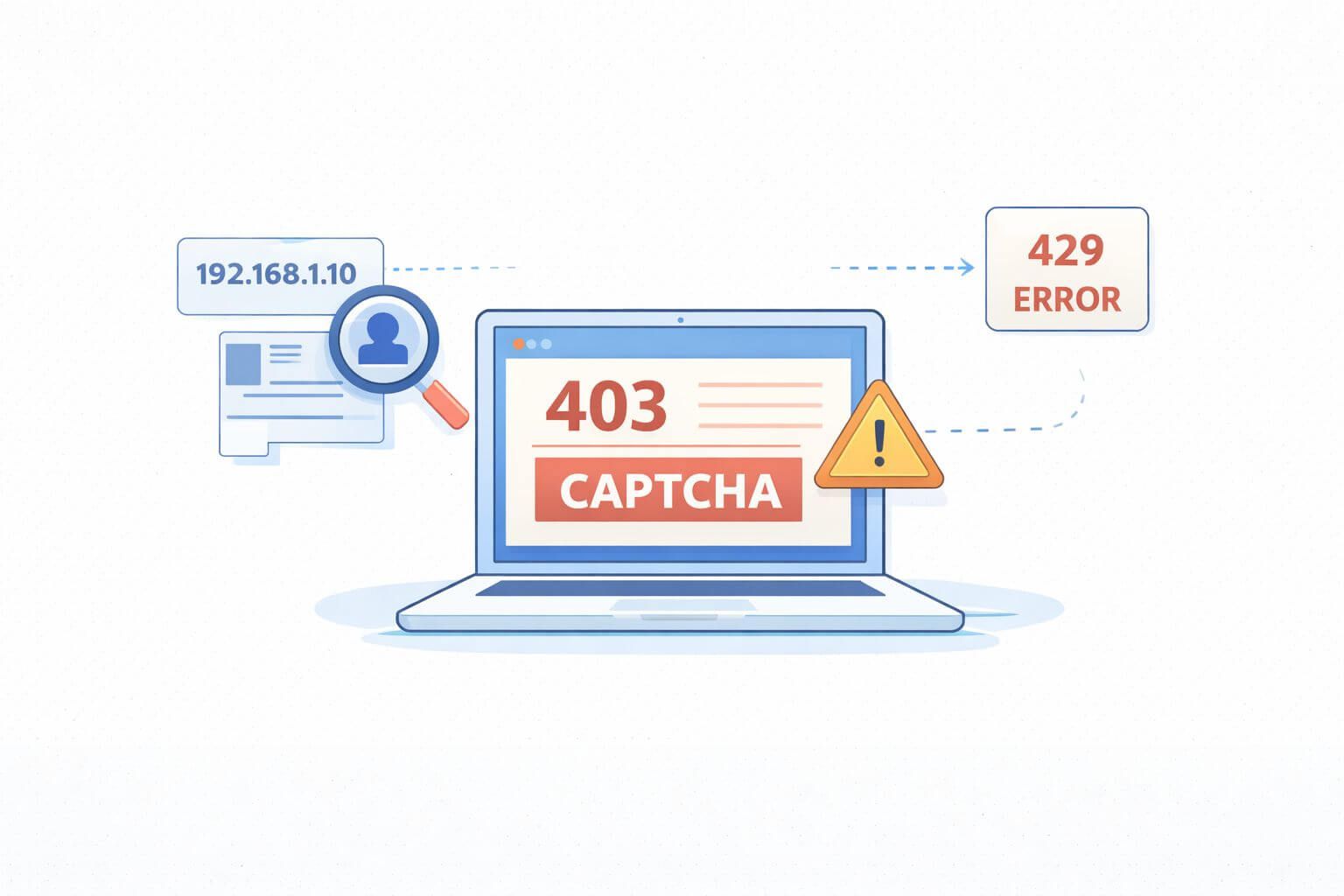
Most sites detect automation with rate limits, IP reputation, and session anomalies. If one IP makes too many requests, uses rare routes, or flips geos, you’ll see 429s, 403s, or captchas.
A session is a persistent state between client and site. It holds cookies, logins, carts, or tokens. Rotation that discards the session or changes IP too aggressively can trigger forced logouts or fraud flags.
Production-ready proxy rotation strategies
Start with simple, testable policies. Add complexity only when the data says you need it.
- Sticky-session rotation: "Sticky" means the same IP is reused for a session time-to-live (TTL). Use it for login, cart, or multi-step flows. Rotate after N minutes or M requests, or when signals spike.
- Request-level rotation: Change IP every request for public pages or high-parallel scraping. Throttle and randomize timing to mimic human variability.
- Geo- and ASN-aware pools: Keep consistent country or region per session. Avoid frequent hopping across geos or autonomous systems unless your users actually do that.
- Signal-based swapping: Swap IPs on captchas, unusual response codes (403/429), or fingerprint mismatches. Consider a cooldown for suspect IPs.
These proxy rotation strategies trade raw speed for durability. Use sticky sessions where stateful behavior is required. Use aggressive rotation for stateless fetches behind caching CDNs. Combine time-based and signal-based triggers for resilience.
Building a rotation policy (template)
- Define flows: public pages vs. authenticated vs. checkout.
- Choose session type: sticky vs. request-level.
- Set cadence: rotate every X minutes or Y requests.
- Set signals: swap on consecutive 429/403, captcha hits, or geo drift.
- Cap concurrency per IP: stop single-IP bursts.
- Add pool hygiene: retire IPs with poor success rate.
When to use residential IPs for rotation
Residential IPs are assigned to real consumer devices and carry more natural traffic profiles. They often pass reputation filters better than pure server ranges.
Use residential when you need higher deliverability on consumer sites, sensitive search pages, social, or dynamic content behind WAFs. They also help with precise geo targeting in cities or suburbs.
For a deeper primer on fit and tradeoffs, see our overview of residential proxies.
When datacenter IPs win for speed and scale
Datacenter IPs come from hosting providers. They’re fast, cheap per request, and great for high-volume, stateless collection.
Use them for product feeds, price monitoring on tolerant endpoints, sitemap traversal, or API-like pages with lighter anti-bot pressure. They’re also good for internal ETL pipelines where speed matters and risk is moderate.
If you’re evaluating throughput and cost efficiency, review how datacenter proxies compare under load.
Match rotation to your workflow (decision aid)
Pick cadence and session type to match the actual user journey you’re simulating. Over-rotating when state matters is a common failure.
| Workflow | Rotation cadence | Session type | Signals to watch |
|---|---|---|---|
| Public listing pages | Per request or every 1–3 requests | Stateless | 429/403 rate, captcha hits, TTFB variability |
| Authenticated dashboards | Every 10–30 minutes or job-run | Sticky | Login resets, CSRF errors, token invalidation |
| Cart/checkout flows | Until order completes | Sticky | 3DS or bot checks, address validation loops |
| API-like endpoints | Time-based (5–15 min) | Sticky or Stateless | Rate-limit headers, burst penalties |
For broader context on verticals and tasks, scan these common proxy use cases as you map flows to rotation policies.
Implementation details that protect sessions
Keep the basics tight before chasing advanced tactics. Many bans come from small inconsistencies.
- Respect cookies: Persist and replay cookies per sticky session. Don’t mix cookies across IPs.
- Keep client hints steady: Hold User-Agent and key headers constant within a session. Rotate them only when IP changes.
- Pace your bursts: Spread requests across time. Add jitter (small, random delays) to mimic natural browsing.
- Align DNS and geo: Use exit nodes aligned with target locale. Avoid geo-hopping mid-session.
- Handle TLS and HTTP/2 gracefully: Maintain protocol consistency within a session; sudden changes can raise suspicion.
Monitoring: measure success, then iterate
Make rotation a measurable system. Tie changes to hard signals.
Key metrics to track:
- Block rate: Percent of 403/429 or explicit block pages.
- Success rate: Share of requests that return expected content.
- Captcha challenge rate: Challenges per 100 requests, by route.
- Concurrency per IP: Peak parallel requests per exit node.
- Session stability: Average session lifetime before forced logout.
- Geo accuracy: Requests served from intended country/region.
Example targets to validate in a pilot (adjust to your domain):
- Block rate below a level that keeps retries and costs tolerable.
- Session lifetime long enough to finish multi-step tasks with margin.
- Captcha rate stable and predictable under planned concurrency.
Two real-world scenarios
Travel price collection: Public search pages allow request-level rotation but throttle bursts. Rotating every request with paced concurrency and region-consistent exits cut blocks. Adding a cooldown for IPs that hit 429 twice stabilized success.
Retail cart automation: Checkout spans 4–7 steps with anti-fraud checks. Sticky sessions with 20-minute TTLs survived login and address entry. IP swaps only on explicit blocks. Keeping UA and headers fixed inside the session prevented order resets.
Watch out for this (common pitfalls)
- Treating all routes the same: Product pages, search results, and checkout often need different cadence and session types.
- Over-rotating mid-session: Swapping IPs while logged in triggers re-auth or suspicion.
- Geo drift: Jumping countries or ASNs inside a session raises flags.
- Ignoring pool hygiene: Reusing "hot" IPs with recent blocks spreads pain.
- Concurrency spikes: Too many parallel hits per IP or per route looks like an attack.
- Mixing device fingerprints: Rotating UA every request while keeping a sticky IP is inconsistent behavior.
Tuning cadence: time-based vs. signal-based
Time-based rotation is predictable and easy to reason about. Signal-based rotation reacts to real conditions. In practice, combine them.
- Baseline: Rotate every X minutes or Y requests.
- Overrides: If captcha rate or 429s jump past a threshold, swap sooner.
- Recovery: Cooldown or quarantine IPs with poor performance for Z minutes.
This hybrid keeps sessions healthy while avoiding persistent pain from a “bad” IP.
Capacity and cost thinking
Rotation affects how many IPs you need and how you spread them. Sticky sessions raise IP consumption when concurrency is high. Request-level rotation can reuse IPs more quickly but risks bursts.
Budget for:
- Pool size: Enough unique IPs to keep per-IP concurrency low.
- Geo coverage: Separate pools by region or country.
- Session TTL: Longer TTLs consume more IP-minutes.
- Retries: Factor expected retry headroom from pilot data.
FAQs: Proxy rotation without broken sessions
How do I pick between sticky and per-request rotation?
- If the flow stores state (login, cart, multi-step forms), use sticky. If it’s stateless public pages, rotate per request or every few requests. When unsure, start sticky and A/B test time-based rotation during non-critical steps.
What signals should trigger an immediate IP swap?
- Consecutive 429/403 responses, captcha hits that exceed a safe rate, or unexpected login resets. Consider swapping if TTFB jumps unusually for that route, which may indicate throttling.
Can I reuse an IP after a block?
- Yes, but quarantine it. Put it in cooldown and only reintroduce it to less sensitive routes. Track per-IP success over time and retire chronic offenders.
Do residential IPs eliminate captchas?
- No. They often reduce friction on consumer sites, but captchas depend on behavior, timing, and content patterns. Validate impact in a pilot before committing pool size.
How many proxies do I need for N concurrent threads?
- It depends on target tolerance, per-IP concurrency, and rotation cadence. Start with a conservative per-IP concurrency (for example, single digits), then increase based on measured block rate and success.
Why do my sessions still reset even with sticky proxies?
- Check cookie persistence, token lifetimes, and client hints. If you change UA or key headers mid-session, or geo drifts, sites may force re-auth. Align rotation boundaries with authentication lifecycles.
Is datacenter viable for sensitive targets?
- Sometimes. With low bursts, good pacing, and stable sessions, datacenter can pass. If pressure rises, switch flows that struggle to residential or mix pools by route.
How should I test rotation changes safely?
- Use canary cohorts. Apply new cadence to a small percentage of traffic, watch block and captcha rates for a fixed window, then roll forward or back. Keep dashboards per route and per IP pool.
Bringing it together: a practical path
Start small. Map each route to a rotation style. Implement sticky sessions for stateful flows and request-level rotation for public pages. Add time-based rotation first, then layer on signal-based swaps for resilience.
Monitor block rate, success rate, captcha hit rate, session lifetime, and geo accuracy. Tune per-IP concurrency and session TTLs. Quarantine weak IPs and prefer stable pools.
If you’re comparing network types for specific flows, read more on datacenter proxies and when to switch routes to residential proxies. To see how different verticals pair with rotation styles, skim these proxy use cases. For deeper engineering patterns and rollouts, explore our technical guides.
The key insight: effective proxy rotation strategies balance cadence and consistency. Reduce blocks by rotating on time and on signals, but protect sessions by keeping state, headers, and geo stable. Next, validate a pilot with clear thresholds, expand gradually, and keep tuning based on measured results.
About the author
Elena Kovacs
Elena Kovacs works at the intersection of data strategy and proxy infrastructure. She designs scalable, geo-targeted data collection frameworks for SEO monitoring, market intelligence, and AI datasets. Her writing explores how proxy networks enable reliable, compliant data acquisition at scale.